Car Centres
Showing posts with label Coupe. Show all posts

Thursday, September 15, 2011

2012 Porsche 911 By TopCar

2012 Porsche 911
2012 Porsche 911

There was never doubt that the new Porsche 911 was supposed to be one of the most anticipated cars of 2011. The question is not so much as "it would be really cool?" more than "how big will it be?"

That's the difference between a car like the 911 and almost everything else on the market. You do not question the authority of the former. You just ask yourself how you will be able to afford one. For companies, auto tuning, the same questions can be asked, albeit in another context: "As soon as we can build a program for it?"

2012 Porsche 911
2012 Porsche 911

In the case of Russia tuner, TopCar, the project has already begun, despite the fact that the 911 has yet to make its debut around the world. TopCar already in front curb to the extent that they already have sketches of what their program for the 911 it will look.

Details of the project is still being kept secret, but we learned something about her, including the body, which will be built using carbon and Kevlar. Furthermore, the relevant set will carry new items, including new front and rear bumpers, air intakes, new exhaust system.

2012 Porsche 911
2012 Porsche 911

We also found that TopCar employs some of the best aftermarket companies for the project, including 9ff, which will handle the transmission settings and ADV.1 wheels that will take care of specially designed wheels TopCar 911.

More details on the 2012 Porsche 911/991

 2012 Porsche 911

Expect TopCar 911 to make his first public appearance in March 2012, along with his own performance TechArt of 911/991. Between these two projects, we need a lot of time to decide which model we will fill our piggy bank to buy.

911 is the most successful model in the history of Porsche. He began his long history dates back to 1963 and since then Porsche offers five different generations: 911 Classic, 964 series, 993 series, 996 series and 997 series. After a long wait and greetings from the official images of the theft, Porsche showed its sixth generation ahead of its official debut in 2011 Frankfurt Motor Show.

This may be a bit unorthodox for the Porsche will be bringing out the 911 generation, despite the fact that they just showed a facelift version, but needs are constantly changing, and Porsche has to answer the call of duty. Their last goal of improving fuel consumption and emissions of CO2.

Sixth-generation 911, or 991, is a brand new car, but all recognize it as 911. Shortly after the launch of 998 911, Porsche will also issue Turbo, GT2, GT3, and in 2012.

Saturday, September 3, 2011

2012 Porsche 911 GT3 R

2012 Porsche 911 GT3 R

Before the new 911/991 mercy Frankfurt Motor Show floor, Porsche 911 is a summing current series in 2012 racing car GT3 R, a model that was successful due to great handling and speed. The new model year is taking these features with the addition of more horsepower and accessories.

2012 Porsche 911 GT3 R Engine

Porsche 911 GT3 R is powered by a four-liter six-cylinder flat engine, which provides a total of 500 hp, 20 hp improvement due to to optimize the intake system. Six-speed sequential gearbox was adapted to the higher maximum power and paddleshifters were mounted on the handlebars for easy and quick gear changes. Transmission electronics, featuring automatic flash control throttle, further facilitates shifting. Race-ABS braking system rolls over from the previous model year, as it makes it difficult to ex-factory traction control.

2012 Porsche 911 GT3 R Interior

The new GT3 R is still located between the 911 GT3 Cup GT3 RSR, and will be used in the competition, starting next year. It will be on sale in November 2011 at a price of 304,500 euros, or about $ 434,000 on current exchange rates. If you just so happen to own 2010 or 2011 GT3 R, do not worry, Porsche is in the process clients to update their model 2012 specifications for 43 100 euros, or about $ 61000.

2012 Porsche 911 GT3 R Interior

2012 Porsche 911 GT3 R

2012 Porsche 911 SP91-R by Speedart

2012 Porsche 911 SP91-R by Speedart

We all know that the 2012 Porsche 911 will be good dealer when the car hits the market in the near future. But the car is already setup program waiting in the wings before it makes its world premiere just goes to show how anticipated this brand-spankin 'new 911 really is.

It is not surprising that setting a firm that produced this package SpeedART, one of the best specialists of aftermarket Porsche in the world. As part of its "SP91-R ', SpeedART preparing large-scale project, which will include a new aerodynamic body kit, wheels and performance upgrade kit.

Under aero kit, SpeedART gives the new 911 front spoiler, side skirts, rear diffuser, rear spoiler, as well as a set of 21 "LSC-forged wheels on the exterior. All this will lead to minimal changes in the interior, with a special leather and Alcantara trims be only add-on. There's also a new suspension setup, whose owners may be able to use for street and track targets.

As for the performance upgrade will install SpeedART new set of power punches before the 3.4L direct-injected 911 engine flat six from the standard 350 horsepower up to 435 horsepower.

Obviously, there are no official photos of the vehicle while seeing as it's only going to make its world debut in Frankfurt in a few weeks. For its part, SpeedART looks at the introduction of SP91-R in 2011 Essen Motor Show this year.

This should give us enough time to ads on the first tuning program for all new Porsche 911.

2012 Porsche 911 Carrera 4 GTS

2012 porsche 911
2012 Porsche 911 

2012 Porsche 911
2012 Porsche 911 

2012 Porsche 928
2012 Porsche 928
2012 Porsche 911
2012 Porsche 911 

2012 Porsche 911 Carrera 4

Saturday, August 6, 2011

2011 Lotus Exige Matte Black


2011 Lotus Elise

Lotus Cars is a British manufacturer of sports and racing cars based at the former site of RAF Hethel, a World War II airfield in Norfolk. The company designs and builds race and production automobiles of light weight and fine handling characteristics.

Lotus is owned by Proton who took over after the bankruptcy of former owner Romano Artioli in 1994.

2011 Lotus Elise front

The company was formed as Lotus Engineering Ltd. by engineer Colin Chapman, a graduate of University College, London, in 1952. The first factory was in old stables behind the Railway Hotel in Hornsey, North London. Team Lotus, which was split off from Lotus Engineering in 1954, was active and competitive in Formula One racing from 1958 to 1994. The Lotus Group of Companies was formed in 1959. This was made up of Lotus Cars Limited and Lotus Components Limited which focused on road cars and customer competition car production respectively. Lotus Components Limited became Lotus Racing Limited in 1971 but the newly renamed entity ceased operation in the same year.
The company moved to a purpose built factory at Cheshunt in 1959 and since 1966 the company has occupied a modern factory and road test facility at Hethel, near Wymondham. This site is the former RAF Hethel base and the test track uses sections of the old runway.

Chapman died of a heart attack in 1982 at the age of 54, having begun life an innkeeper's son and ended a multi-millionaire industrialist in post-war Britain. The car maker built tens of thousands of successful racing and road cars and won the Formula One World Championship seven times. At the time of his death he was linked with the DeLorean scandal over the use of government subsidies for the production of the DeLorean DMC-12 for which Lotus had designed the chassis.

In 1986, the company was bought by General Motors. On 27 August 1993, GM sold the company, for £30 million, to A.C.B.N. Holdings S.A. of Luxembourg, a company controlled by Italian businessman Romano Artioli, who also owned Bugatti Automobili SpA. In 1996, a majority share in Lotus was sold to Perusahaan Otomobil Nasional Bhd (Proton), a Malaysian car company listed on the Kuala Lumpur Stock Exchange.

The company also acts as an engineering consultancy, providing engineering development—particularly of suspension—for other car manufacturers. The lesser known Powertrain department is responsible for the design and development of the 4-cylinder Ecotec engine found in many of GM's Vauxhall, Opel, Saab, Chevrolet and Saturn cars. Today, the current Lotus Elise and Exige models use the 1.8L VVTL-i I4 from Toyota's late Celica GT-S and the Matrix XRS.

The company is organised as Group Lotus, which is divided into Lotus Cars and Lotus Engineering.

Michael Kimberley took over as Acting Chief Executive Officer of the Company and its Group from May 2006. He currently chairs the Executive Committee of Lotus Group International Limited ("LGIL") established in February 2006, with Syed Zainal Abidin (Managing Director of Proton Holdings Berhad) and Badrul Feisal (non-executive director of Proton Holdings Berhad). LGIL is the holding company of Lotus Group Plc.

Kimberley retired as CEO on 17 July 2009 and was replaced as CEO by Dany T Bahar on 1 October 2009. Bahar was formerly Senior Vice President, Commercial & Brand for Ferrari SpA where he was responsible for worldwide road car sales and after sales business, overall road car and F1 marketing activities, licensing, and merchandising business.

The four letters in the middle of the logo stand for the initials of Anthony Colin Bruce Chapman.

2011 Lotus Elise side

Current Lotus models include:
  • Lotus Elise: The Elise started in 1996 and weighed 725 kg. The current model starts at 901 kg and incorporates some engineering innovations, such as an aluminium extrusion frame and a composite body shell. The Elise has also spawned several racing variants, including a limited series called the 340R, which has an open-body design echoing the old Seven. The Elise was introduced into the U.S., with a Toyota engine, in order to pass strict U.S. emissions laws. The 1ZZ & 2ZZ Toyota engines used have a Lotus ECU with their own fuel mapping. The supercharged Lotus SC and limited edition Jim Clark Type 25 Elise editions add a new performance dimension to the Elise range. 0–60 mph acceleration is in 4.3 seconds and 0–100 km/h in 4.6 seconds.
  • Lotus Exige: A version of the Elise with a redesigned body to provide additional downforce (100 lb at 100 mph). Additionally, the following Elise Sport Pack and Hardtop options are standard on the Exige. The car is street legal and the base 2006 model was available in the USA for $50,990. Lotus updated the Exige with the supercharged Exige S in 2007.
  • Lotus Exige S: An Exige with a supercharged engine providing 220 hp. The non-S Exige and Elise have 190 hp (140 kW).
  • Lotus Evora Launched 22 July 2008. Code named Project Eagle during development. A 2+2 sports car with a mid mounted, transverse 3.5 litre V6 engine.
  • Lotus 2-Eleven Weighing just 670 kg (1,500 lb) and with 252 bhp (188 kW) the Lotus 2-Eleven can sprint from 0–60 in 3.8 seconds and has a top speed of 155 mph (249 km/h). Intended as a track day car it costs £39,995 but for an additional £1,100 Lotus will make the car fully road legal.
  • Lotus T125 Exos Track-only Formula 1 inspired car. 3.5l Cosworth V8, 640 bhp; 25 will be built at $1 million each. To run in the 'Exos Experience by Lotus', a club, initiated and operated by Lotus Motorsport, in which a limited number of owner drivers can refine their driving skills and challenge themselves with expert one-to-one advice from former Grand Prix drivers and trainers.

2011 Lotus Evora exterior concept

Lotus Mark I (1948): Austin 7 based car
Lotus Mark II (1949–1950): Ford-powered trials car
Lotus Mark III (1951): 750 cc formula car
Lotus Mark IV (1952): Trials car
Lotus Mark V (1952 2): 750 cc formula car—never built
Lotus Mark VI (1953–1955): The first "production" racer—about 100 built
Lotus Seven (1957–1970): Classic open sports car, a minimalist machine designed to manoeuvre a racing circuit and nothing else. The rights to the Seven were sold in 1973 to Caterham Cars, who continue to produce it today. Updated versions of this 1957 design are also produced by other speciality firms, including Westfield Sportscars and Donkervoort. Originally the number seven was applied to a Riley-powered Formula 2 car, but the vehicle was never completed in its original form, finally emerging instead as the Clairmonte Special, a two-seat sports car powered by a Lea-Francis engine.
Lotus Mark VIII (1954): sports racer
Lotus Mark IX (1955): sports racer, based on Eight
Lotus Mark X (1955): sports racer, a more powerful Eight
Lotus Eleven (1956–1957): sports racer
Lotus 12 (1956–1957): Formula Two and Formula One racecar
Lotus 13: Designation not used
Lotus 14 (1957–1963): First production street car—the Elite
Lotus 15 (1958): Sports racer—successor to the Eleven
Lotus 16 (1958–1959): F1/F2 car based on the Twelve
Lotus 17 (1959): Sports racer update of the 15—not successful
Lotus 18 (1960–1961): First mid-engined Lotus single seater—Formula Junior/F2/F1
Lotus 19 (1960–1962): Mid-engined sports racer—"Monte Carlo"
Lotus 20 (1961): Formula Junior
Lotus 21 (1961): Formula One
Lotus 22 (1962–1965): Formula Junior/F3
Lotus 23 (1962–1966): Small displacement mid-engined sports racer
Lotus 24 (1962): Formula One
Lotus 25 (1962–1964): Formula One World Champion
Lotus 26 (1962–1971): Production street sports car—the original Elan.
Lotus 27 (1963): Formula Junior
Lotus 28 (1963–1966): Lotus version of the Ford Cortina street/racer
Lotus 29 (1963): Indy car—Ford stock block
Lotus 30 (1964): Large displacement sports racer (Ford V8)
Lotus 31 (1964–1966): Formula Three space frame racer
Lotus 32 (1964–1965): Monocoque F2 and Tasman Cup racer
Lotus 33 (1964–1965): Formula One World Champion
Lotus 34 (1964): Indy car—DOHC Ford
Lotus 35 (1965): F2/F3/FB
Lotus 36 (1965–1968): Fixed Head Coupe version of the original Elan, so called perhaps to distinguish it from the Type 26 Elan which could be fitted with a removable hard top)
Lotus 38 (1965): Indy winning mid-engined car
Lotus 39 (1965–1966): Tasman Cup formula car
Lotus 40 (1965): Improved(?) version of the 30
Lotus 41 (1965–1968): Formula Three, Formula Two, Formula B
Lotus 42 (1967): Indy car—raced with Ford V8
Lotus 43 (1966): Formula One
Lotus 44 (1967): Formula Two
Lotus 45 (1966–1974): Convertible (Drop Head Coupe), a version of the original Elan with a revised body style, most notable for its permanent side window frames.
Lotus 46 (1966–1968): Original Renault-engined Europa
Lotus 47 (1966–1970): Racing version of Europa
Lotus 48 (1967): Formula Two
Lotus 49 (1967–1969): Formula One World Champion
Lotus 50 (1967–1974): Four-seat "Elan +2" production car
Lotus 51 (1967–1969): Formula Ford
Lotus 52 (1968): Prototype "Europa" twincam
Lotus 53 (1968): Small displacement sports racer—never built
Lotus 54 (1968–1970): Series 2 "Europa" production car.
Lotus 55 (1968): F3
Lotus 56 (1968–1971): Indy turbine wedge/F1 turbine (56B)
Lotus 57 (1968): F2 design study
Lotus 58 (1968): F1 design study
Lotus 59 (1969–1970): F2/F3/Formula Ford
Lotus 60 (1970–1973): Greatly modified version of the Seven—AKA Seven S4
Lotus 61 (1969): Formula Ford wedge
Lotus 62 (1969): prototype Europa racer
Lotus 63 (1969): 4-wheel drive F1
Lotus 64 (1969): 4-wheel drive Indy cars—did not compete
Lotus 65 (1969–1971): "Federalized" Europa S2
Lotus 66: designation not used
Lotus 67 (1970): Proposed Tasman Cup car—never built
Lotus 68 (1969): F5000 prototype
Lotus 69 (1970): F2/F3/Formula Ford
Lotus 70 (1970): F5000/Formula A
Lotus 71: Undisclosed design study
Lotus 72 (1970–1972): Formula One World Champion
Lotus 73 (1972–1973): F3
Lotus 74 (1971–1975): Europa Twin Cam production cars
Lotus 75 (1974–1982): Luxury 4 seat GT—"Elite II"
Lotus 76 (1975–1982): Fastback version of Elite II—"Éclat S1"—also 1974 F1
Lotus 77 (1976): F1
Lotus 78 (1977–1978): F1 ground effects car
Lotus 79 (1978–1979): Formula One World Champion—also street GT "Esprit" (1975–1980)
Lotus 80 (1979): F1
Lotus 81 (1980–1981): F1—designation also used for Sunbeam Talbot rally car
Lotus 82 (1982–1987): Turbo Esprit street GT car
Lotus 83 (1980): Elite series 2
Lotus 84 (1980–1982): Éclat series 2
Lotus 85 (1980–1987): Esprit series 3
Lotus 86 (1980–1983): F1 dual chassis—never raced
Lotus 87 (1980–1982): F1
Lotus 88 (1981): F1 dual chassis car—banned
Lotus 89 (1982–1992): Lotus Excel GT—re-engineered Éclat
Lotus 90: Unreleased Elan/Toyota
Lotus 91 (1982): F1
Lotus 92 (1983): F1
Lotus 93T (1983): F1 Turbo
Lotus 94T (1983): F1 Turbo
Lotus 95T (1984): F1 Turbo
Lotus 96T (1984): Indy car project—abandoned
Lotus 97T (1985–1986): F1 Turbo
Lotus 98T (1986–1987): F1 Turbo
Lotus 99T (1987): F1 Turbo—last Lotus F1 winner
Lotus 100T (1988): F1 Turbo
Lotus Elan (Type M100) (1989–1995): Front-drive convertible Elan.
Lotus 101 (1989): F1
Lotus 102 (1990–1991): F1
Lotus 103 (1990): F1—not produced
Lotus 104 (1990–1992): Lotus Carlton: tuned version of the standard Vauxhall saloon.
Lotus 105 (1990): Racing X180R IMSA Supercars Drivers Champ Doc Bundy
Lotus 106 (1991): X180R roadgoing homologation special
Lotus 107 (1992–1994): F1
Lotus 108 (1992): a bicycle ridden by Chris Boardman to win a gold medal at the 1992 Barcelona Olympics, also known as the "LotusSport Pursuit Bicycle".
Lotus 109 (1994): F1—Last Lotus F1 car.
Lotus 110: Production version of type 108 bicycle
Lotus 111: The Lotus Elise
Lotus 112: Final partial F1 design, got as far as the monocoque buck
Lotus 113: Number not allocated
Lotus 114 (1996): Lotus Esprit GT1
Lotus 115 (1997–1998): Lotus GT Race Car, AKA Lotus Elise GT1
Lotus 116: The Vauxhall VX220 / Opel Speedster, a collaboration with GM
Lotus 117: Lotus Elise Mk2
Lotus 118: Lotus M250. Two-seater concept car. Unveiled in Autumn of 1999 as a mid-range sports car, project was cancelled in 2001.
Lotus 119: Soapbox derby car Light vehicle out of carbon and aluminium, brakes discs, without engine, built for the race of the festival of speed of Goodwood
Lotus 120 (1998): Elise V6 code named M120—was never produced
Lotus 121 (2006): Europa S
Lotus 122: Lotus Evora
Lotus 123: Lotus 2-Eleven
Lotus 124: Evora Race Car
Lotus 125: Exos—Ultimate track Car
Lotus Excel (1985–1992): Updated Eclat with Toyota running gear. 2,159 Excels were made.
Lotus Eclat (1975–1982): Fastback version of the Elite. The rear roof line of the Elite was sloped down into a sporty fastback.
Lotus Elite: Describes two cars, one an ultra-light two-seater coupé produced from 1957 to 1962, one an angular 3-door hatch with a back bone chassis produced from 1974 to 1982.
Lotus Europa (1966–1975): mid-engine sports car.
Lotus Esprit: A mid-engined sports car, launched in the early 1970s. It was styled by Italian designer Giorgetto Giugiaro. The Esprit started with a light, 4-cylinder design, which went through several iterations of turbo-charging and electronic upgrades, before finally being replaced by a highly advanced V8. The last Lotus Esprit rolled off the production line on 20 February 2004, after 28 years in production. A total of 10,675 Esprits were built since production began in 1976.
Lotus M250 (2000): Concept car that never reached production
Lotus Europa S: The Grand Tourer (GT)-inspired two-seater is claimed to offer a more upmarket sportscar experience, although it is based on the same chassis as the Elise and Exige, limiting accommodation and practicality. Power comes from a Lotus-tuned variant of the turbocharged four-cylinder engine which powers the VX220. The Europa has been criticised in the motoring press for being expensive and for lacking equipment and practicality compared to rivals like the Porsche Cayman.

2011 Lotus Evora

At the 2010 Paris Motorshow, Lotus announced five new models to be introduced over the next five years:
New Lotus Esprit. Due to be released in 2013, the Esprit will be powered by a 4.8 litre Lotus Performance V8 pressure charged engine delivering up to 620 PS, capable of 0–100 km/h in approximately 3.4 seconds.
New Lotus Elan. Set for release during the second half of 2017, the Elan will feature a 4.0 litre V6 pressure charged engine capable of delivering up to 450 PS with a weight of 1,295 kg.It has been confirmed that the Elan has been shelved
New Lotus Elite. A 2+2 GT with a front-mid positioned 5.0 litre V8 engine delivering up to 620 PS, capable of 0–100 km/h in approximately 3.7 seconds. Set for release in spring 2014,
New Lotus Elise. The replacement for the Lotus Elise is due in 2015 with a 2.0 litre inline 4 pressure charged engine delivering up to 320 PS, the Elise 2015 is stated to be capable of 0–100 km/h in under 4.5 seconds.
New Lotus Eterne. A four door, four seater sports GT. With a 5.0 litre pressure charged V8. Designed as a competitor to the Porsche Panamera and the Aston Martin Rapide.

2011 Lotus Elise black
2011 Lotus Elise

Lotus Evora
Lotus Evora

2011 Lotus
2011 Lotus

2011 Lotus
2011 Lotus

2011 Lotus Elise
2011 Lotus Elise

Sunday, July 31, 2011

New Porsche 911/991

On your marks ... get ready ... and get ready to order! Source revealed that Porsche dealers are almost ready to open the order books for new and improved 911/991. Orders can be taken as early as next month, with vehicle deliveries scheduled in March - April 2012.

That's not all, either. Want to order Porsche 911/991? There's an app for that! Our source also revealed that Porsche is developing IPad application that will allow customers to play with the parameters and place your order on the latest technological wonder from Apple. Porsche and Apple, now there is a marriage made in heaven.

As a reminder for those who have been living under a rock stupidity, the new Porsche 911/991 will be powered by a 3.4L direct-injection flat-six engine, which provides a total of 350 hp at 6,400 rpm and maximum torque of 280 lb-ft between 4400 and 6000 rpm. Carrera S gets a 3.8-liter flat six with direct fuel injection, which provides a total of 400 hp at 7,000 revolutions per minute, leaving him with 4.5 seconds 0-60mph sprint time and a top speed of 188mph. Both models will be offered with either a seven-gear or seven-speed PDK dual-clutch automatic, both made by ZF, and both with launch control. These models also come with improved fuel economy of 12-15%.


Porsche 911 991


Porsche 911 991


New Porsche 911 991
New Porsche 911/991

Porsche 911 991


Porsche 911 991 Interior


Porsche 911
Porsche 911

Porsche 911
Porsche 911

Wednesday, July 27, 2011

2011 Lotus Evora S Police Car

2011 Lotus Evora
2011 Lotus Evora

2011 Lotus Evora
2011 Lotus Evora

2011 Lotus Evora
2011 Lotus Evora

2011 Lotus Evora
2011 Lotus Evora

Bad Boys I Italy would have serious cause for concern as close to the Lamborghini Gallardo Police Car Carabinieri in Rome just got a new Lotus Evora S for their police fleet. Evora S models will be available for units based in Rome and Milan. The new police car will be used to provide essential public services.
This special Evora S will be equipped with some of the latest voice recognition technology, including EVA (Enhanced Automated Vehicle) system. Special refrigeration compartment portable was installed behind the front seats that allow for quick delivery of vital organs and blood is required for medical emergencies.

Evora S is equipped with a supercharged Toyota-sourced 3.5-liter V6, which will supply a total of 350bhp and 300lb more of torque. This means acceleration from 0 to 60 miles / h in 5.0 seconds and a top speed of over 172mph.

2011 Maserati GranTurismo

In its standard version of Maserati GranTurismo MC Stradale delivers a total of 450 hp - An impressive output over the standard GranTurismo at 420 HP, but nothing compared to the fact that DMC is capable of. German tuner found an easy way to increase power to 590HP, and threw it into the interior and exterior package as a bonus.

2011 Maserati GranTurismo

In order to obtain additional 140 hp, DMC decided a couple of 4.7-liter Maserati V8 engine with a supercharger and a new exhaust system. These simple additions make it possible to DMC MC Stradale a dragon breathing fire.

2011 Maserati GranTurismo

All other modifications will be considered chump change next to the engine increase, but the DMC to solve internal and external anyway. The exterior was smoothed with a lot of parts Cabron fiber, including a new front bumper, new spoiler for improved downforce and new air inlets and outlets, as well as new side skirts, wide body. Rear of the vehicle gets the boot rear spoiler and rear diffuser, while the whole look is finished off with a new set of 20 "forged wheels. As for the interior, DMC choice in favor of genuine leather with carbon fiber for the seats, doors, instrument panel, and salon-ski.

2011 Maserati GranTurismo

Our only problem with this package that they dropped the last MC Stradale package they have created. The model was put forward last year all the way to 600 hp and featured a couple of other features to help external drive together, the three vents, one on each side, consisting of three aerial ladder to go with a cooling hole in the center.

2011 Maserati GranTurismo


Saturday, July 16, 2011

2012 SSC Ultimate Aero II

The battle for the title of "world's fastest production car" just hot - again. And this time around its two classic David vs. Goliath encounter: the diminutive Shelby Super Cars acquires the power of VW-owned Bugatti. American solo exhibition SSC, made the world take them seriously after the original Ultimate Aero snatched the title from the Veyron with the launch of 256mph, recorded on a four-mile Texas with one-way traffic, which showed dogleg bend, you need to navigate to the "just" 210mph. The man behind the wheel was 71 years old Chuck Bigelow, who had no racing experience and even refused to wear a protective helmet.

Pushing back, Veyron Super Sport came to the ultra-modern, ultra-smooth and wide Ehra VW test track in Lessien, with a professional driver at the wheel, and a crowd of engineers at their disposal. The result was a spectacular 267mph on the special edition of the 1200HP.

Considering all that Bugatti have at their disposal, compared with Jerod Shelby and his team of 16 engineers - who work from a garage behind his house - you begin to understand the magnitude of their achievement. Now, they presented their new creations, 1350HP RWD beast is not yet an official name. For convenience, we shall simply call Aero II.

UPDATE 07/14/2011: Reports that the SSC is in the final stages of implementing their new supercar after the legendary Ultimate Aero, once considered the fastest car on the planet.

Although there was no evidence that the car will have a name - the word is that the SSC is preparing to tease him in front of her debut 2013 - Many people go out and dubbed it as "Ultimate Aero II '.

2012 SSC Ultimate Aero II
2012 SSC Ultimate Aero II 

Exterior Design

Outgoing Ultimate Aero was very general in its appearance. The body, like the rest of the car was designed by company owner Jerod Shelby (no relation to the muscle car legend Carroll Shelby). He recognizes that the need for slippery aerodynamics governed by the final product and being an engineer by profession, the design was not his forte. Enter the American Italian designer Jason Castriota, who at the beginning, reservations about taking on the project. We can not blame him after looking at his impressive resume. He wrote the car for the best in the industry: Ferrari, Pininfarina, Rolls Royce, and Bertone, to name just a few of them. The last thing that his career had to design a car designed for failure for a small company with more hope than money or brains. After visiting the facility and familiarity with the staff and more importantly, their ideals and the car, he took the plunge and created what you see before you.

2012 SSC Ultimate Aero II Exterior

The result is stunning, especially when you clear the body of work to identify how technically difficult it was to overcome the terrible forces of nature at 200 miles / h +, while packing the necessary mechanical components. It is a great example as a function of assembly to create a harmonious whole. We like black tears form a canopy, which is located at the top of the white exterior, creating a stunning contrast of strength and beauty. The form of the classical and fundamental, and has very low resistance rate. The car has a dihedral wings or stabilizers, which have been borrowed from the aviation field. The term "flying support" could be interpreted as being a bit naughty, but they are actually wings, which help maintain the structure of the vehicle. In this case, they are bits on the side of the SSC Aero II, which feed air to the engine intake - Castriota signature design.

2012 SSC Ultimate Aero II Exterior

The front looks scary and focused with his low-slung nose and headlights carbon fiber. Looking carefully, you will notice ventilation to carbon brakes and a cohesive front splitter, which generates enough downforce to keep the nose planted at high speed. There is no hood or trunk, or any compromises with this car. Side profile sleek and sexy - there are no door handles or side repeaters, and the car barely worth more than a meter tall. Massive lower house of deepening inlets in the front of the rear wheel arches and feed the hungry and the engine cooling radiator with a much needed cool air, while its contribution to balance the look. It checks all the boxes hypercar and much more. Elements of the first Aero is supported, first of all party piece of the door and spoke wheel design simple. Last first ever one piece carbon fiber wheel ever installed on a car. They are products of an Australian company, Carbon Revolution, and 19 "fronts weigh just 5.8kg each.

2012 SSC Ultimate Aero II Wheels

The whole body and chassis, with the exception of the front and rear zones of influence, all made of carbon fiber - further emphasizing the lightness in your keywords. It is not necessary for maximum speed, but more for everyday driving and handling. All mid-engined cars require holes in the back to help get rid of heat - they usually take the form of slats or louvers, but since this car is nothing, but it has a circular cut outs in different diameters to expel heat and a pub debate. Moving to the other behind, the dynamics take over, with the aesthetics of playing second fiddle. Total underneath the car is sealed, leading to the rear, which functions as the mother of all cones, complete with F1-style exhaust. From this point of view, it bears little resemblance to the R8 and small, we mean small - proportion and shape are similar. Between the rear stabilizers, hydraulic brake air - a la Bugatti Veyron and Merc SLR, which comes into play at a higher than permitted speeds. Measurement of the wise, Aero II slightly narrower than before to follow the rules FIA GT, if they decide a race.

2012 SSC Ultimate Aero II

Interior

 The interior remains a mystery - probably because it is not 100% finished - but we can guess about what to expect. There will be room for two with all the creature comforts, like seat belts and air conditioning. We would not bet on heated and electric massage seats just yet. Judging by the old model, whose interior was rather casually, the interior of the new car should be better and get the basics right. We believe that the design will be based on a large screen LCD and a central quality of finish is better - after all, this car is really worth a drop of less than $ 1 million.

2012 SSC Ultimate Aero II

Performance

 You really need to ask? The figures on paper are striking enough - even before getting to the actual time of work and statistics. Invited to record powered by a four-camera, a twin-turbo V8 displacing 6.8 liters. The engine, like all other mechanical parts, which are all developed in house SSC itself. Many new shares power with the old 6.2-liter point - the block and the interior is the same design, so are the size and location of its 10 radiators. Changes come in the form of four valves per cylinder overhead cam (OHC) installed, and do not push the bar and the new specifications SSC turbochargers. New plants that are good for 1350HP and tremendous speed at 9000RPM! From zero to 62mph arrives in about 2.8 seconds and a top speed of SSC claim, wait for it, 275mph! Figures gear acceleration is not known yet, but you can be assured that they will be absolutely mind blowing. Thank God, the new car will include traction control, ABS with servo assist, and Brembo carbon-ceramic stoppers. We can not even imagine that kind of power to allow freely on public roads without fear of being arrested by the long arm of the law, feeling of acceleration, will rip your face. This thing should sound as it goes - all the turbo whistle and growl, angry V8.

Because it is RWD, not 4WD, as our friend Veyron, it's easier ... much easier. Aero II weighs 1200kgs, 638kgs total is easier than the relatively chubby Bugatti - and it produces more power. You do not need to be a rocket scientist to realize that the power to weight ratio is more than a ton 1000HP, placing it in league Caparo T1. Where Bugatti is a luxurious, refined, and civilized, to move, Aero II is a raucous, relentless, and about as scary as getting shave from Edward Scissorhands.

Suspension is the same setup coilover and so does the triple carbon clutch plates. Whether it goes so well round corners in direct remains to be seen. One thing is certain, though, it will create pants on fire every time you use the pedal on the right.

2012 SSC Ultimate Aero II Interior
 2012 SSC Ultimate Aero II Interior

Competition

 In short, there is no other competition, except for the Veyron SS, and it costs $ 2.4 million, more than twice as much as $ 970 000 Aero II. You can also buy Agera Koenigsegg, but the price is unconfirmed, and therefore the maximum speed. Cars must be closely linked, but we think it depends on personal preference and if you are on the whole "mine more than yours" thing. Hopefully, the Aero II will not squeak, rattle or fall apart like so many other cars made by small firms in small quantities. The first cars will be delivered to their proud new owners around the last quarter of 2011.

Only time will tell whether the SSC will bring the top speed crown back to the U.S..

Monday, February 8, 2010

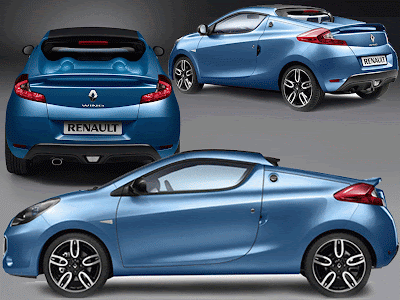
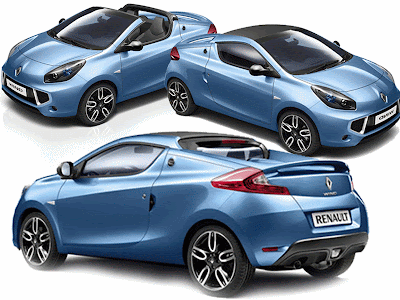
2011 Renault Wind Sport coupe-roadster

2011 Renault Wind Sport coupe-roadster 

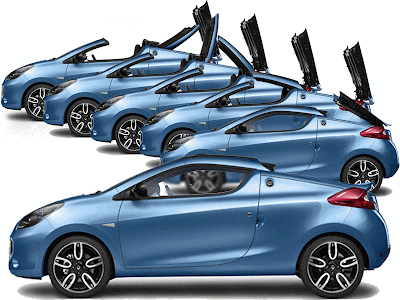
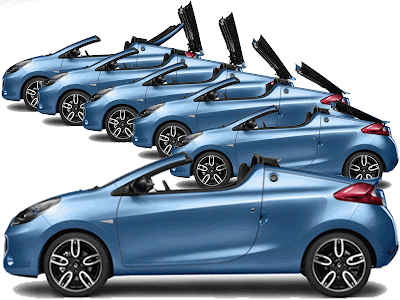
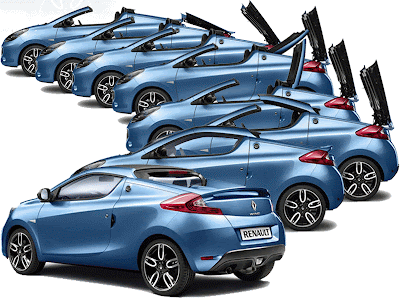
Renault announced its plans to unveil the brand-new Wind coupe-roadster at the upcoming Geneva Motor Show 2010 on 2 March. The 2011 Renault Wind is designed for two persons. Despite the fact that Renault pitches the car as a coupe-roadster, unlike other CC models with retractable hardtops, the Wind uses an exclusively innovative electric roof that rotates 180 degrees into the trunk, which is capable to open in just 12 seconds.
2011 Renault Wind Sport coupe-roadster 

Renault Wind brings a completely different take on a car for drivers who enjoy wind-in-the-hair motoring. Renault Wind is aimed at motorists who lust after a car that is not only distinctive and compact, but also convertible yet practical enough for everyday use.
2011 Renault Wind Sport coupe-roadster 

Advantages of this car is the only car of its class to provide just as much luggage space (270dm3 VDA) whatever the position of the roof.  The Renault Wind has a 3.83 metres in length which features a highly innovative way of opening up. The strictly two-seater model shares its platform and mechanical hardware with the Twingo, though at 3.830mm long, it's 230mm longer than the hatchback.
2011 Renault Wind Sport coupe-roadster 

The French automaker is keeping a tight lid on other details for now, but it is expected that the Wind will be offered with two of the Twingo's petrol engines, a 1.2-liter turbo with 100HP and a naturally aspirated 1.6-liter unit with 133HP.
2011 Renault Wind Sport coupe-roadster 

Although Renault Wind’s compact dimensions make it a nimble machine in and about town, it is the only car of its class to provide just as much luggage space (270dm3 VDA) whatever the position of the roof. True to Renault's brand signature "Drive the Change", Wind makes passion affordable for everyone.
 
2011 Renault Wind Sport coupe-roadster
Related Posts Plugin for WordPress, Blogger...


blogger templates | Car Centres